
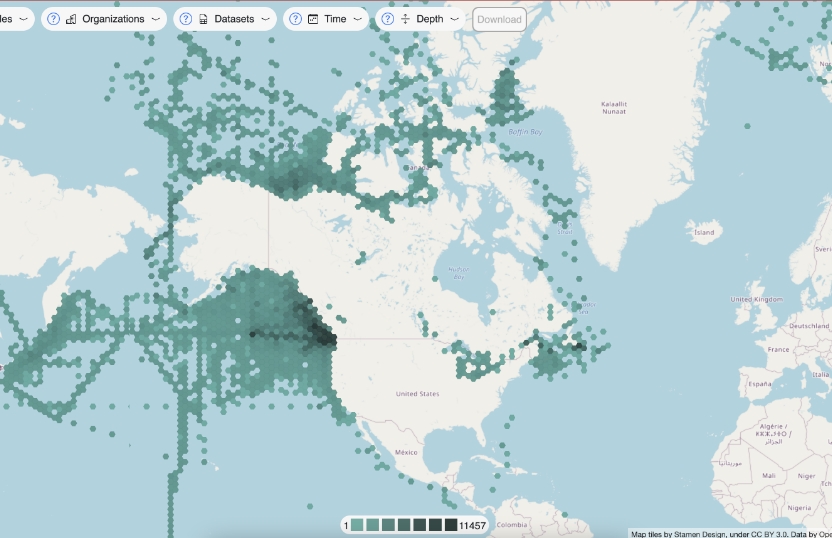
At present, CIOOS is comprised of three Regional Associations. CIOOS is actively engaging with potential partner organizations in the Great Lakes, the Arctic, and Inuit Nunangat with the intent of adding RAs in these areas. If you have any questions about whether CIOOS can support your data’s geographic extent, reach out to us at info@cioospacific.ca.
Ocean Data For
For the health of our oceans
For the future of coastal communities
For the growth of the blue economy
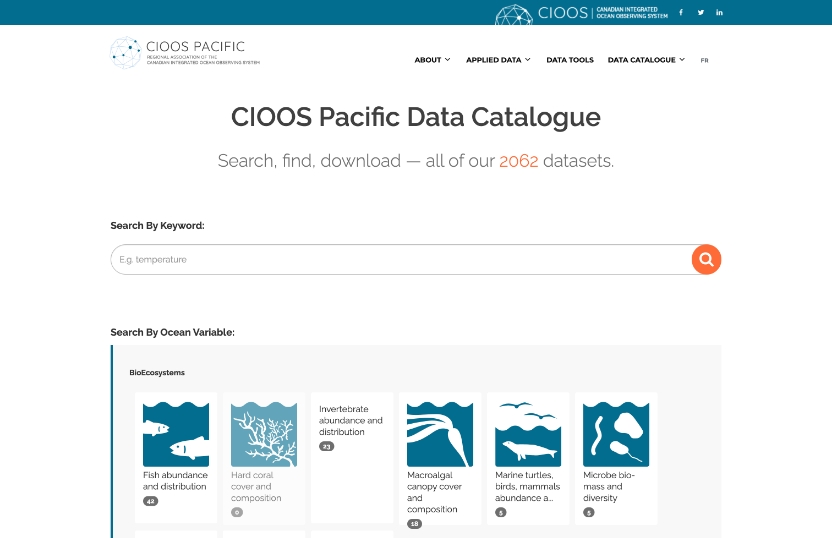
CIOOS Pacific’s data hub for Canada’s west coast
The Canadian Integrated Ocean Observing System (CIOOS) is a powerful open-access platform for sharing information about the state of our oceans.
Observe, explore, and share knowledge to better understand the Pacific Ocean
CIOOS Pacific provides ocean observing resources to support maritime economies and communities, research, and education. Guides, tools, technical documents, and collaborative initiatives: these resources help disseminate best practices and strengthen Canada’s open ocean science community.

CIOOS Pacific is the regional hub for ocean data aggregation on Canada’s west coast to make marine data more accessible to everyone.
Get Involved
The oceans are changing, as are our needs for knowledge and collaboration.
CIOOS invites researchers, decision-makers, and partners to join forces to advance ocean science.
The CIOOS team is here to listen to your needs and discuss your projects. Whether you want to access or share data, collaborate on an initiative, or simply learn more about our services, our grant funding enables us to support you and guide you towards the right tools, partners, and resources.
Frequently Asked Questions
What is CIOOS?
The Canadian Integrated Ocean Observing System (CIOOS) fosters discovery of and access to high quality ocean data and information. This is accomplished through our open-access platform that delivers observational data and associated metadata in a consistent format. If you are a data provider, we help others to find and access your data more easily. We also create regional data products that help to turn our partners’ data into ocean intelligence tools.
The foundation of CIOOS is to make data more findable, accessible, interoperable, and reproducible (FAIR).
Who benefits from CIOOS?
CIOOS benefits both data providers and users across the ocean community. Academics, government agencies, ocean industries, coastal and Indigenous communities, and non-governmental organizations are key target audiences for our data services. That said, all Canadians will benefit from improved data access for decision makers and the tools that are developed from turning those data into information and knowledge for all.
Are Indigenous groups involved with CIOOS?
Yes! CIOOS has ongoing engagement and dialogue with Indigenous governments, organizations and communities. Together, we are exploring best practices for preservation of Indigenous ocean knowledge and data in ways that support Indigenous data sovereignty. CIOOS has adopted CARE (Collective benefit, Authority to control, Responsibility, and Ethics) Principles for Indigenous Data Governance. Contact us to become part of the conversation.
There are currently similar initiatives that also focus on collecting ocean data. How is CIOOS different?
CIOOS works to address fragmented and isolated Canadian data by creating an open-access platform that facilitates discovery of previously inaccessible and undiscoverable data to end-users on a national scale. This integrated approach helps to coordinate the national management of ocean data and, critically, is adaptable in the face of growing needs and a changing environment. Furthermore, the improved coordination of regional and national efforts within CIOOS contributes to global ocean observing, maximizing the overall benefit of integrated observing.
How is CIOOS funded?
CIOOS is primarily funded through grants from Fisheries and Oceans Canada (DFO) and the Marine Environmental Observation and Prediction Network (MEOPAR). CIOOS Pacific also receives critical matching funds for these grants from Ocean Networks Canada, which is an Initiative of the University of Victoria. Ocean Networks Canada also hosts the CIOOS Pacific offices at the University of Victoria Queenswood Campus.
Is the use of CIOOS free of charge for data users? What about data providers?
CIOOS is free for data users and data providers thanks to our grant funding. If you have special data requests, we are happy to explore whether we can support those with our existing resources or whether we may need to pursue additional support. Reach out to us any time to discuss at info@cioospacific.ca!
Does CIOOS offer training?
Some training materials are already available on our resources pages or via the national CIOOS website. Current trainings focus primarily on ERDDAP and data management but reach out to us with any special requests at info@cioospacific.ca.